Paying the same invoice twice sounds like something that only happens to careless businesses. It happens to careful ones all the time, for reasons that have nothing to do with care: a supplier sends a reminder, the same invoice arrives by email and by post, or the same supplier gets set up twice in your accounts.
This guide explains how duplicates slip through, why simple checks miss them, and how to catch them before the money leaves.
How duplicates get paid
Almost every duplicate payment starts one of these ways:
- The same invoice arrives twice. By email and by post, or a reminder that looks like a new bill.
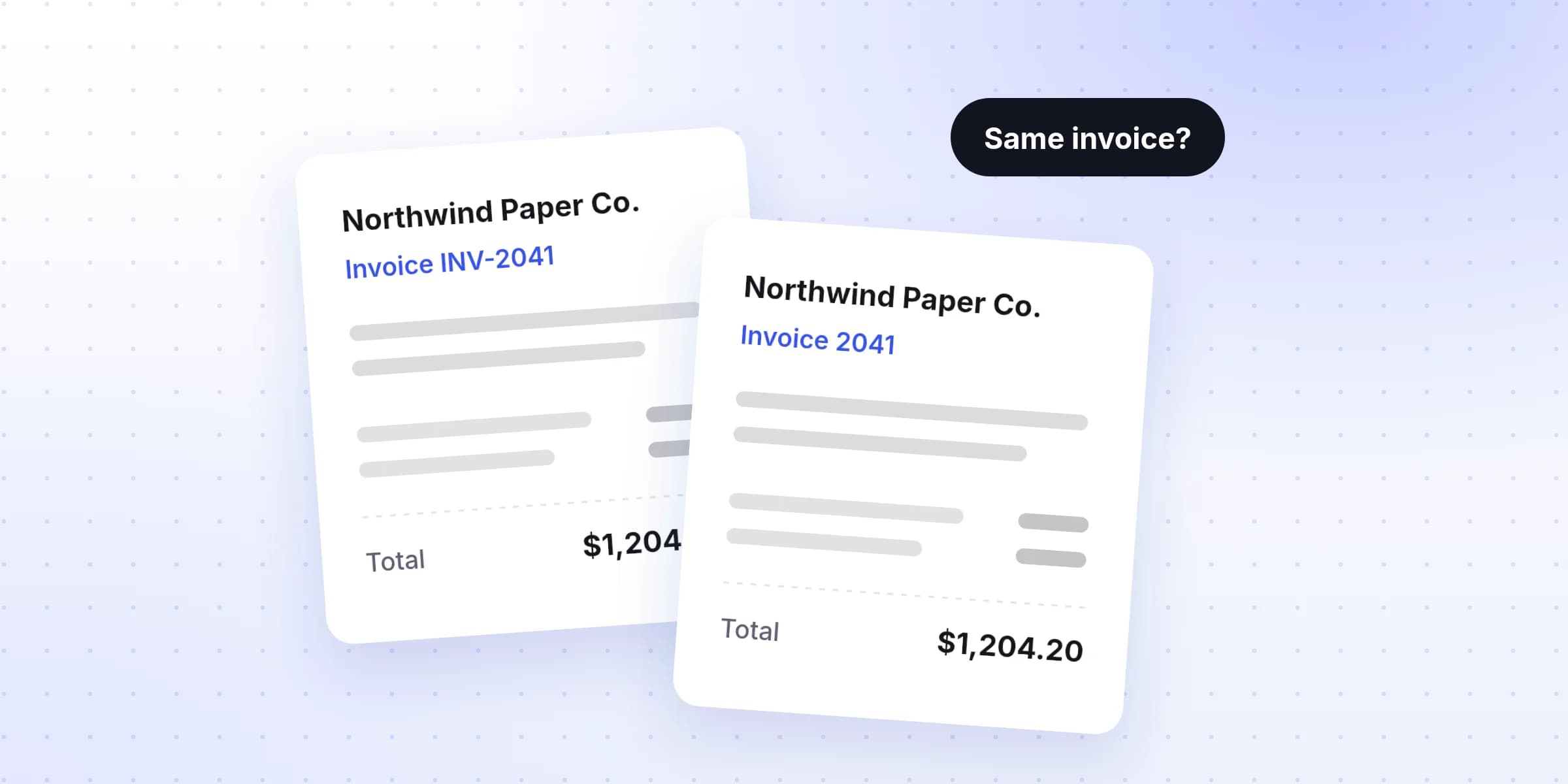
- The invoice number is written differently. “INV-2041” and “2041” look different to a computer and to a tired person.
- The supplier is in your system twice. “Northwind Paper” and “Northwind Paper Co. Ltd” are treated as two suppliers, so their invoices are never compared.
- Someone pays an invoice another person already paid. Common when invoices sit in personal inboxes instead of one shared place.
Real audits find exactly these causes. When the City of Springfield, Massachusetts, audited its payments, it found ten duplicate payments in one year worth $43,172. The causes it listed were “identical invoices with different invoice numbers” and suppliers set up more than once. A later check found 135 suppliers that appeared under different supplier numbers with the same tax ID.
Spot the duplicate
Each case shows two invoices. Are they the same invoice, or two different ones?
Same invoice, or two?
0 of 4 answered
Case 1
The same invoice number, written two ways
- First
- Northwind Paper · INV-2041 · $1,204.20 · Nov 1
- Second
- Northwind Paper · 2041 · $1,204.20 · Nov 1
Case 2
Same amount every month
- First
- City Cleaning · 0318 · $450.00 · Oct 1
- Second
- City Cleaning · 0331 · $450.00 · Nov 1
Case 3
One supplier under two names
- First
- Northwind Paper · 2077 · $860.00 · Nov 12
- Second
- Northwind Paper Co. Ltd · 2077 · $860.00 · Nov 12
Case 4
A reminder arrives
- First
- Harbor Print · 5510 · $2,300.00 · Oct 20
- Second
- Harbor Print · 5510 · $2,300.00 · Reminder sent Nov 5
Why simple checks miss them, or cry wolf
Most accounting software will warn you if you enter the same supplier and the same invoice number twice. That catches the easy case and misses the others above: a number written differently, or a supplier set up twice.
The opposite problem is just as real. A check that is too loose flags everything that looks similar, and people soon learn to click past it. When the Texas Comptroller reviewed three years of state payments, the state's system had flagged 367,847 “potential duplicate payments” worth $921.9 million. When agencies looked into $285.4 million of them, $1.17 million turned out to be real duplicates.
0.4%
Source: Texas Comptroller of Public Accounts, multi-agency desk audit of duplicate payments, 2021. $1,166,963.51 confirmed out of $285,371,790.77 investigated.
A good duplicate check looks at several things together, the supplier, the number, the amount and the date, and allows for small differences in how each is written. That way it stops the real duplicates without stopping every monthly bill.
The same checks catch fake invoices
Duplicates are usually mistakes. Fake invoices aren't, and they're common. The Association of Certified Fraud Examiners studies fraud cases inside organizations every two years. In its 2024 report, billing schemes, where someone gets an organization to pay invoices it shouldn't, were involved in 22% of cases, with a median loss of $100,000.
Fraud by people inside organizations
Share of fraud cases involving each kind of theft, by employees, managers or owners
The typical billing scheme ran for 18 months before anyone noticed. The same habits that catch duplicates, one list of suppliers and a second look at anything unusual, also make fake invoices much harder to slip through.
How to stop paying twice
- 1
Have one place where invoices arrive
If every invoice comes to one shared address, the same invoice arriving twice is visible at once. - 2
Merge suppliers that appear twice
Look for suppliers that appear twice under slightly different names, and merge them. Check tax or VAT numbers: two suppliers with the same number are the same supplier. - 3
Compare more than the invoice number
Before paying, look for any invoice from the same supplier with the same amount and a similar date or number. - 4
Treat reminders as questions, not bills
When a reminder arrives, check whether the original was paid. If it was, reply to the supplier with the payment date. - 5
Mark invoices as paid in one place
Whoever pays an invoice marks it as paid where everyone can see it, so nobody pays it again from their own inbox.
Before paying an invoice
- No other invoice from this supplier has the same amount and a similar date.
- The invoice number doesn't match an earlier one, however it's written.
- This isn't a reminder for an invoice we've already paid.
- The supplier isn't in our list twice under another name.
Where Invoist fits
Invoist compares each new invoice with the ones it has already read from the same supplier and holds likely duplicates for you to check, so a reminder or a resent invoice doesn't reach your accounting software twice. See how Invoist flags invoices.