If your business is VAT registered, the VAT on what you buy is money you can usually get back. But only with the right paperwork: HMRC treats a valid VAT invoice as the main proof you're entitled to it. An invoice missing a VAT number or a date can mean VAT you can't reclaim.
This guide lists what a VAT invoice must show, lets you check one, and explains what to do when it's wrong.
Why the invoice matters
HMRC's record-keeping guide, VAT Notice 700/21, says the VAT invoices you receive “are the primary evidence for you to recover VAT you have incurred as input tax”. Input tax is the VAT you pay on things you buy for the business.
Without a valid invoice, HMRC only accepts other evidence “in exceptional circumstances”. Its own manual says that where a business doesn't have a VAT invoice, it “must go back to the supplier and request one”.
20%
Source: GOV.UK, VAT rates. Businesses must register for VAT when taxable turnover goes over £90,000 in 12 months.
What a VAT invoice must show
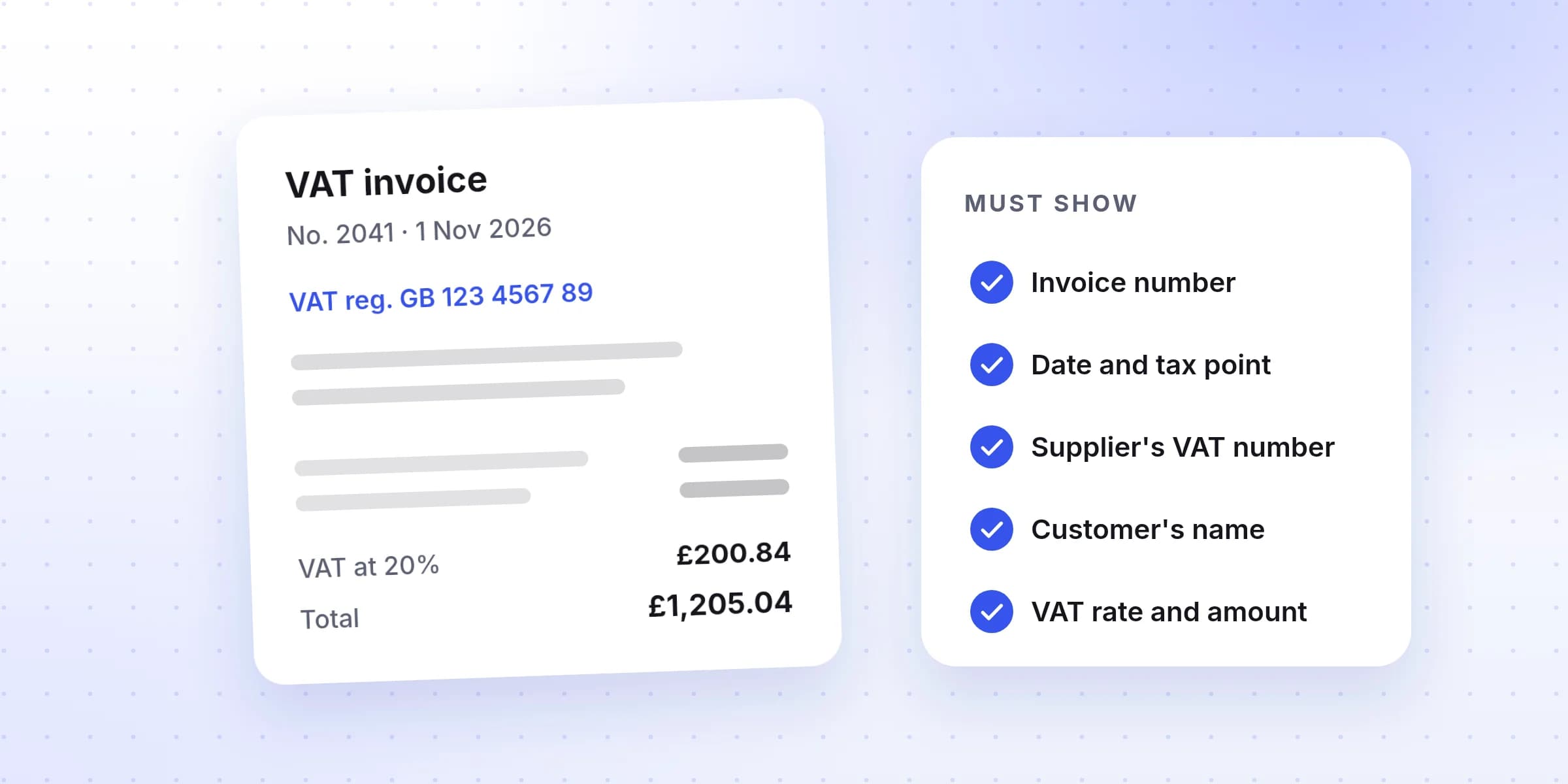
For a full VAT invoice, HMRC lists these details:
- A unique invoice number that follows on from the last one.
- The time of supply, also called the tax point, and the date it was issued if that's different.
- The supplier's name, address and VAT registration number.
- Your name and address, as the customer.
- A description of what was supplied.
- For each item: the quantity, the unit price, the VAT rate and the amount before VAT.
- The total before VAT, and the total VAT, in pounds.
- The rate of any discount offered for paying early.
For sales of £250 or less including VAT, a supplier can give a simplified VAT invoice. It only needs the supplier's name, address and VAT number, the time of supply, a description, and the total including VAT for each rate with the rate charged. You'll see these on many shop and restaurant receipts.
Check an invoice
Pick up any supplier invoice and tick what it shows. The checker tells you whether it counts as a VAT invoice.
Check an invoice
Not a valid VAT invoice yet
6 details are missing
- A unique invoice number that follows on from the last one
- The date, and the time of supply (tax point) if that's different
- The supplier's VAT registration number
- Your name and address
- and 2 more
Ask the supplier for a corrected invoice before you reclaim.
The most common problems
- No VAT number. Without it, you can't tell the supplier is VAT registered, and neither can HMRC. If they charge VAT but aren't registered, that VAT can't be reclaimed.
- Addressed to someone else. An invoice in an employee's personal name rather than the business is a common problem with expenses.
- A receipt that only shows the total. A card machine slip shows what you paid, not the VAT. Ask for a VAT receipt at the till.
- A pro forma. A quote or pro forma invoice isn't a VAT invoice. Wait for the real one after you pay.
Fix a wrong invoice the day it arrives
The cheapest time to fix an invoice is the day it arrives, while the supplier still remembers the sale. When you record an invoice, check it has a VAT number and the VAT amount. If it doesn't, reply asking for a corrected one before you pay. Suppliers are much quicker to fix an invoice before they've been paid.
Where Invoist fits
Invoist reads the supplier, dates, totals and tax amount from each invoice as it arrives, so you can see at a glance which ones are missing the VAT and ask the supplier straight away. See what Invoist reads. This is a general guide; for anything unusual, check with HMRC or your accountant.