When a customer pays late, a small business usually just waits and sends polite reminders. Many don't know that in the UK the law gives them the right to charge interest and a fixed sum on top of the invoice, and the EU has similar rules. You don't have to use that right, but knowing it changes the conversation.
When a payment counts as late
For payments between UK businesses, GOV.UK sets out the rules:
- If you agreed a payment date, the payment is late the day after it. For business deals that date should usually be within 60 days, and within 30 days when the customer is a public authority.
- If you didn't agree a date, the payment is late 30 days after the customer received the invoice or you delivered, whichever was later.
What you can charge
The Late Payment of Commercial Debts (Interest) Act 1998 gives you two things:
- Interest at 8% a year above the Bank of England base rate. The base rate that counts is the one on 30 June or 31 December, whichever came last before the payment was late. It was 3.75% on both dates in 2026, so the rate for 2026 is 11.75% a year.
- A fixed sum for the cost of chasing: £40 for debts under £1,000, £70 for debts from £1,000 to £9,999.99, and £100 for debts of £10,000 or more.
GOV.UK's own worked example: on a £1,000 debt with interest at 8.5%, the yearly interest is £85, or 23p a day, so after 50 days it's £11.50. The calculator below does the same sum with today's rate.
The unpaid invoice
Use the base rate on 30 June or 31 December, whichever came last before the payment was late. It was 3.75% on both dates in 2026.
You can claim
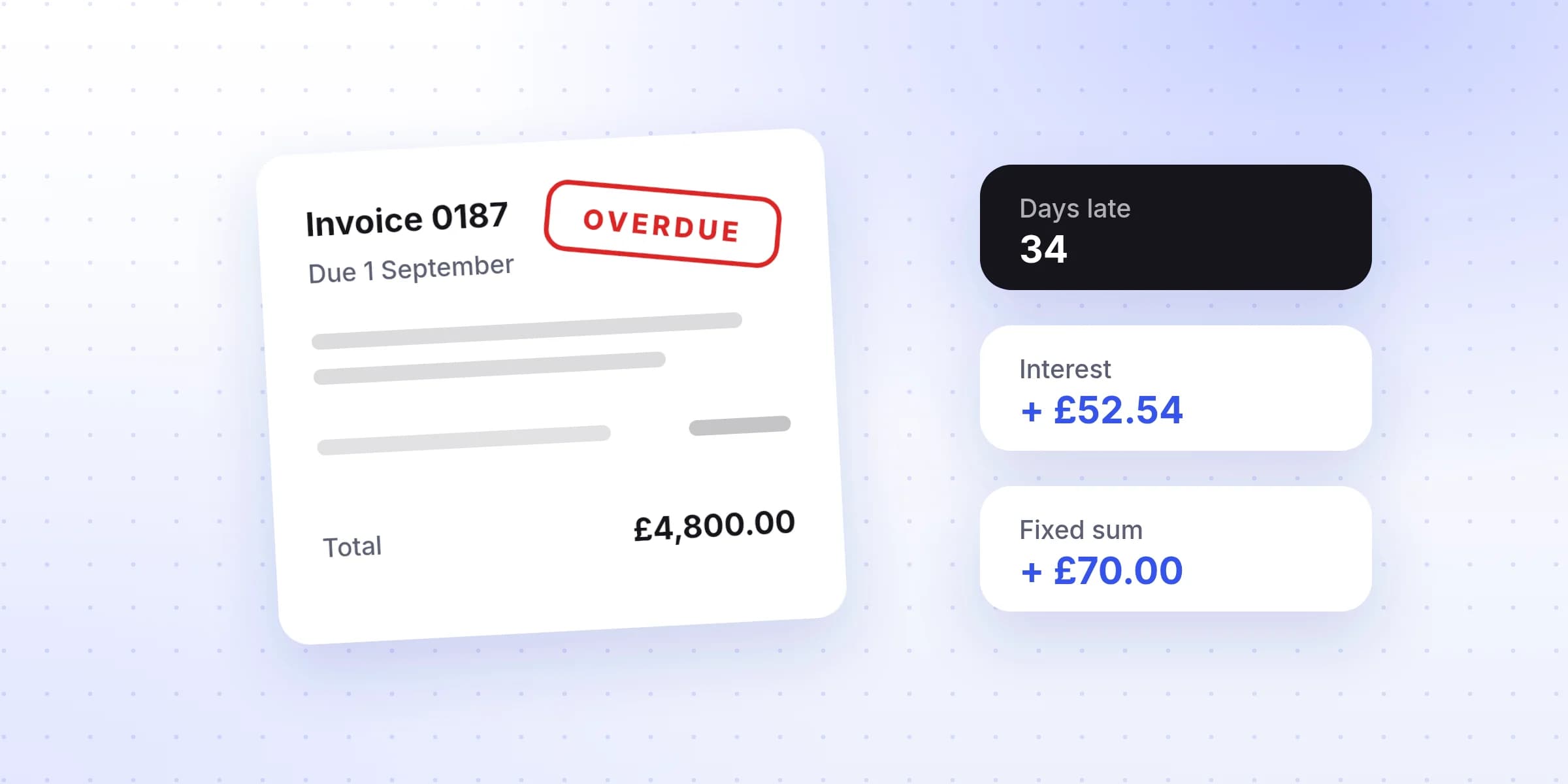
£122.54
- Interest rate
- 11.75% a year
- Interest a day
- £1.55
- Interest for 34 days
- £52.54
- Fixed sum for this debt
- £70.00
Interest keeps adding up each day until you're paid. This is a guide, not legal advice.
How to ask without losing the customer
- 1
Send a friendly reminder the day after the due date
Most late payments are a lost email or an invoice waiting for approval. A quick, polite note fixes many of them. - 2
Mention your right to interest in the second reminder
Say it plainly and calmly. The email below does exactly that, and says you'd rather just be paid. - 3
Phone the person who approves payments
If two emails don't work, a call usually does. Ask what's holding the payment up. - 4
Send a final notice with the amount claimed
List the invoice, the interest so far and the fixed sum, and give a date. If that fails, GOV.UK explains the next steps, including the small claims service.
A second reminder you can copy
Subject: Invoice [number] is now [X] days overdue Hello [name], Our invoice [number] for [amount], dated [date], was due on [due date] and is still unpaid. Under the Late Payment of Commercial Debts (Interest) Act 1998, we're entitled to charge interest at 8% above the Bank of England base rate, plus a fixed sum of [£40 / £70 / £100], on late payments between businesses. We'd much rather just be paid. Could you let me know when we can expect payment? If there's a problem with the invoice, tell me and I'll sort it out straight away. Thank you, [Your name]
In the EU
EU countries follow the Late Payment Directive of 2011. It sets the same kind of rules: payment terms between businesses of no more than 60 days unless clearly agreed otherwise and not grossly unfair, interest of at least 8 percentage points above the European Central Bank's main rate, and at least €40 to cover the cost of collecting. Each country writes the rules into its own law, so the details differ.
In 2023 the European Commission proposed replacing the Directive with a stricter regulation, with a 30-day limit. The European Parliament supported it in 2024, but the EU's member governments haven't agreed their position, and the European Parliament now lists it as blocked.
What's changing in the UK
In May 2026 the government introduced the Commercial Payments Bill. It would cap payment terms at 60 days when large businesses pay smaller suppliers, make interest at 8% above base rate mandatory on their late payments, and give the Small Business Commissioner the power to fine. It finished its stages in the House of Lords in October 2026 but isn't law yet. Until it is, the 1998 Act above is what applies.
Where Invoist fits
This post is about getting paid. Invoist helps with the other side: the invoices your suppliers send you. It reads each one's due date as it arrives, so the bills you owe are checked and approved in time, and you aren't the late payer. See how Invoist works.