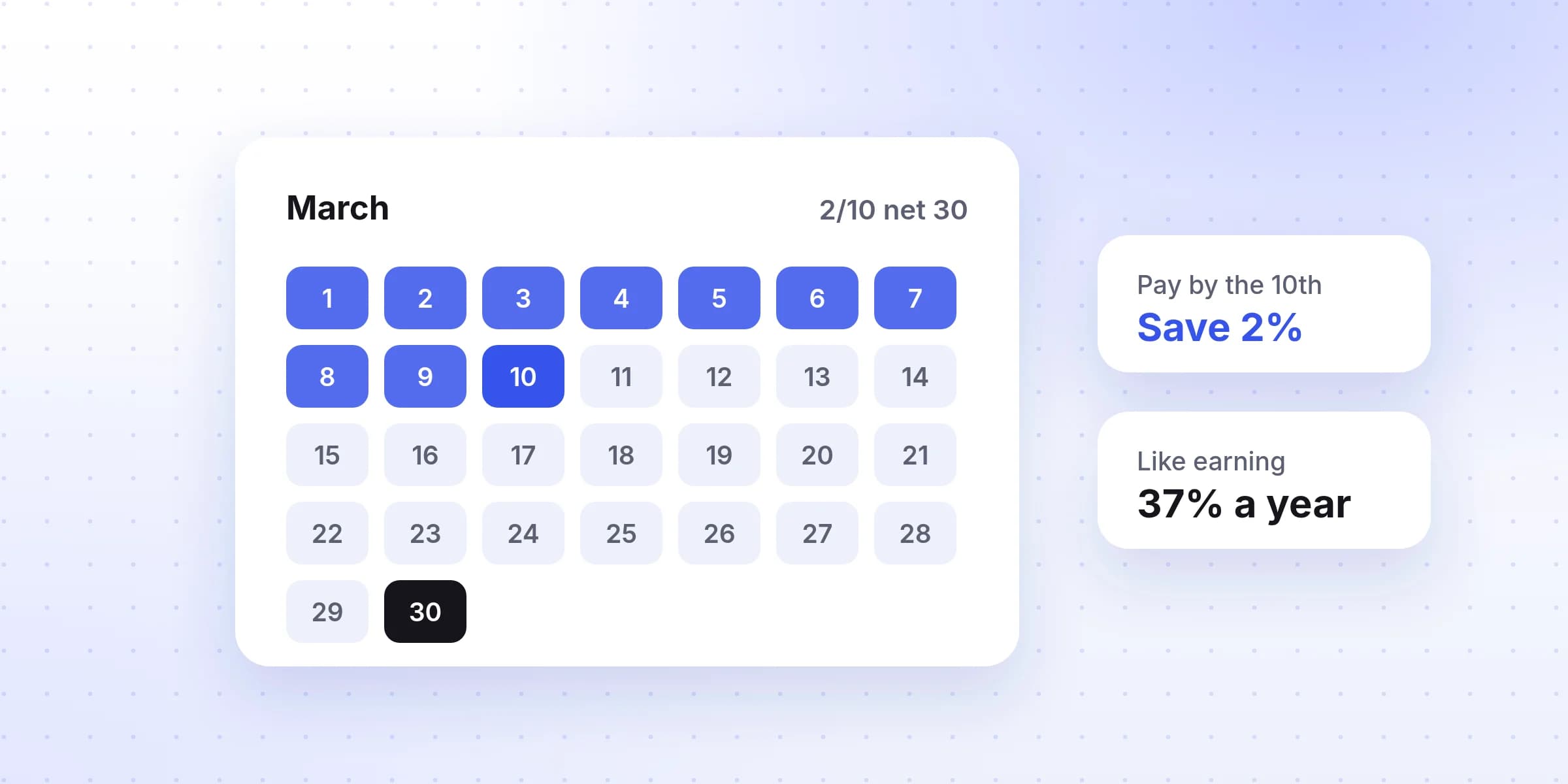
Some supplier invoices carry a line like “2/10 net 30”. It's an offer: pay within 10 days and take 2% off, or pay the full amount within 30. Two percent sounds small, so many businesses ignore it. Worked out as a yearly rate, it's one of the best returns a small business can get on its cash.
How to read the terms
Early payment terms always have the same three parts:
- The first number is the discount. In 2/10 net 30, you can take 2% off the invoice.
- The second number is how many days you have to get it. Here, 10 days from the invoice date.
- “Net” and the last number is when the full amount is due. Here, 30 days.
So on a $5,000 invoice dated March 1 with 2/10 net 30, you can pay $4,900 by March 11, or $5,000 by March 31.
Why 2% is worth more than it looks
The discount isn't a reward for paying at all. It's a reward for paying 20 days sooner. Saving 2% for moving money 20 days earlier is the same as earning about 37% a year on that money.
The standard way to work it out, used in finance textbooks, is the discount divided by what you'd pay, multiplied by how many of those periods fit in a year:
2 ÷ 98 × 365 ÷ 20 = 37.2%
Put the other way round: if you skip the discount, you're paying the supplier the equivalent of 37% a year in interest for the use of their money for 20 days. Few business loans or overdrafts cost that much.
The terms on your invoice
These terms read as 2%/10 net 30
Paying early saves you
$100
As a yearly rate, that's like earning
37.2%
You pay 20 days sooner to save 2%. If your cash earns less than 37% a year, or you'd borrow at less than that, taking the discount wins.
How common terms compare
The rate depends as much on the gap between the two dates as on the discount. The longer you'd otherwise wait, the less paying early earns you.
What paying early earns, as a yearly rate
Common terms as a yearly rate. 2/10 net 30 means 2% off if you pay within 10 days, otherwise the full amount in 30.
Even the weakest of these, 2/10 net 60, works out at about 15% a year. That's still more than most savings accounts pay and more than many business credit lines cost.
When not to take it
The maths says yes almost every time. Cash flow sometimes says no:
- If paying early would leave you short for payroll, rent or tax, keep the cash. A 2% saving isn't worth a missed salary or a late tax payment.
- If you'd have to borrow at a high rate to pay early, compare that rate with the number from the calculator. Borrowing at 25% to earn 37% still wins; borrowing at 45% doesn't.
- If you've missed the date. Taking the discount after the deadline isn't taking a discount, it's underpaying. Most suppliers will ask for the difference, and it sours the relationship.
How to stop missing discount dates
Most discounts aren't turned down. They're missed, because the invoice sat in an inbox until the 10 days were gone. A few habits fix that:
- 1
Note the discount date, not just the due date
When an invoice arrives with early payment terms, write down the date the discount ends. That's the date that matters. - 2
Get invoices approved quickly
Ten days is short if an invoice waits a week to be typed in. The faster an invoice is recorded and approved, the more discounts you can take. - 3
Pay on a fixed day each week
A weekly payment run catches any discount that ends in the next seven days. Sort by the discount date first, then the due date. - 4
Once a quarter, check which discounts you missed
Add up the discounts you took and the ones you missed. If you're missing many, the delay is usually in getting invoices recorded.
Where Invoist fits
Invoist reads the dates, totals and payment details from each supplier invoice as soon as it arrives, so an invoice can be checked and approved in the same week rather than whenever someone gets to the typing. You can see what Invoist reads. The discount decision, and the payment, stay with you.